AI Buzzword Fatigue: Why SaaS Marketing Needs to Focus
- Thomas Gaydos

- Feb 14, 2025
- 4 min read
Updated: May 28, 2025
AI buzzwords are everywhere in SaaS marketing, but customers care about outcomes—here's how to shift your messaging from 'AI-powered' hype to real, tangible value
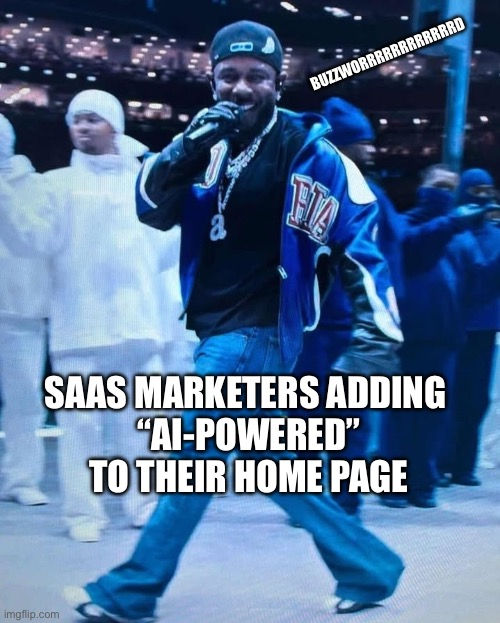
You can’t scroll through a SaaS company’s website or LinkedIn page without bumping into “AI-powered” this or “next-gen AI” that. It’s the default pitch, the magic ingredient, that ethereal thing that supposedly makes a product the magical cure to what ails you.
Except it doesn’t, at least as a headline message expected to differentiate.
AI isn’t a novelty anymore…it’s an expectation. When everything is AI-powered, the phrase itself loses meaning. Customers, especially those making serious buying decisions, aren’t looking for AI - they’re looking for meaningful outcomes and solutions to their problems.
So why is SaaS still stuck in the loop of vague AI jargon? And more importantly, how do companies shift the conversation to something that actually resonates?
The AI Terminology Overload
SaaS marketing has fallen into a predictable pattern involving a familiar set of terms including, but not limited to: “AI-powered”, “Machine learning-driven”, “Next-gen AI“, “Smart AI”, “AI-enabled”. If you add “innovative” and/or “cutting-edge” you’ve almost reached Buzzword BINGO.
These phrases sound impressive and are likely true, but when every product makes the same claim they blend into the background. It’s like the early days of the internet when every business slapped “.com” onto their name to sound innovative—until it became meaningless when everyone had their own web site.
The real issue? This kind of AI marketing was impactful when new and with limited application, but in 2025, the term itself is vague. It doesn’t answer the fundamental question: What does this mean for me as a customer?
The Banner Blindness Effect—Now Applied to AI
There’s a concept in UX called “banner blindness.” Users have seen so many ads that they subconsciously tune them out. The same thing is happening with AI terminology. It’s plastered everywhere, so customers stop noticing.
A 2023 Gartner study found that 64% of B2B buyers express skepticism toward AI-related claims, largely due to a lack of clarity and overuse of generic language.
Customers don’t ignore AI because they don’t care - it’s because they’ve heard it all before. If a SaaS company wants to stand out, it needs to explain what AI actually does for the end user.
What Customers Actually Care About
Let’s get one thing straight: customers truly do love AI - when it solves a problem. They don’t care if an automation tool is “powered by AI.” They care that it cuts manual data entry by 80% so their team can focus on more important tasks.
They don’t buy into “AI-driven insights.” But tell them they’ll see customer churn drop by 25% because the system predicts behavior changes? Now they’re listening.
Here’s what actually matters to buyers:
Efficiency: Does this save me time?
Cost savings: Will this reduce overhead or increase revenue?
Better decision-making: Does this give me insights I wouldn’t have otherwise?
User experience: Does it remove friction from my workflow?
The irony? AI genuinely delivers on these promises, but the messaging around it often fails to connect the dots.
Messaging That Cuts Through the AI Hype
It’s time for SaaS companies to stop selling AI and start selling outcomes means getting specific:
Instead of: “AI-powered automation”
Say: “Automate 80% of manual data entry so your team can focus on strategy.”
Instead of: “AI-driven insights”
Say: “Get real-time customer behavior predictions that increase retention by 25%.”
Instead of: “AI-enhanced workflows”
Say: “Reduce administrative overhead by 40% with smart scheduling suggestions.”
Numbers matter. A 2022 McKinsey report found that SaaS products that clearly communicate measurable AI-driven benefits see 35% higher engagement compared to those relying on broad AI claims.
And here’s the kicker: transparency builds trust. Customers appreciate AI when they understand both its benefits and limitations. If an AI-powered tool automates 80% of tasks but still requires human oversight, say so. Honesty beats hype every time.
AI Done Right: Real-World Examples
Some companies have already figured this out. Instead of drowning their audience in AI jargon, they focus on tangible impact:
Gong: Instead of boasting about “AI-powered sales insights,” Gong tells customers their AI helps sales teams close 27% more deals by analyzing call patterns.
Drift: They don’t push “AI-powered chatbots”—they highlight that their chat solution increases lead conversion by 30%.
Jasper AI: Rather than selling “next-gen AI content generation,” Jasper emphasizes how marketers create copy 10x faster.
These companies understand that AI isn’t the selling point—the business impact is.
Actionable Takeaways for SaaS Marketers
Want to make your AI messaging more effective? Here’s where to start:
Talk to customers – Find out what results they actually care about. You might be promoting “AI-powered personalization” when they really want to hear “increase customer engagement by 50%.”
Use real numbers – Back up AI claims with measurable outcomes. If your AI reduces support tickets by 40%, say so.
Ditch the generic AI phrasing – Swap vague terms for specific benefits. Instead of “AI-driven automation,” say “save 5 hours per employee per week.”
Be transparent – AI isn’t magic. If it’s great at some tasks but requires human oversight for others, explain that. Customers appreciate honesty.
Test your messaging – A/B test AI-focused language versus outcome-driven copy. Track engagement, click-through rates, and conversions.
The Future of AI in SaaS Marketing
AI isn’t going anywhere, but unimaginative AI messaging should. SaaS buyers are smart. They don’t need another buzzword-laden pitch. They need clear, compelling reasons why your product makes their life easier.
Companies that shift from “AI-powered” to “Here’s exactly how this helps you” will win attention, trust, and, ultimately, more customers.
Time to take a fresh look at your AI messaging and ask the question, “are we saying what customers actually want to hear?”
If your SaaS company needs messaging help, check out our SaaS Go-to-Market (GTM) Messaging Workshop to transform your messaging in just two weeks for an affordable price.


